Origins: New Pathways
The Chekhov Collective was originally founded by Cass Fleming in 2013 as part of the long-term practice research project: Michael Chekhov in The Twenty First Century: New Pathways. The Collective played a key role in this research project (2013-2016) and has continued to exist as an organisation seeking new and innovative uses of Chekhov’s techniques in the twenty-first century.
What was the New Pathways Research Project?
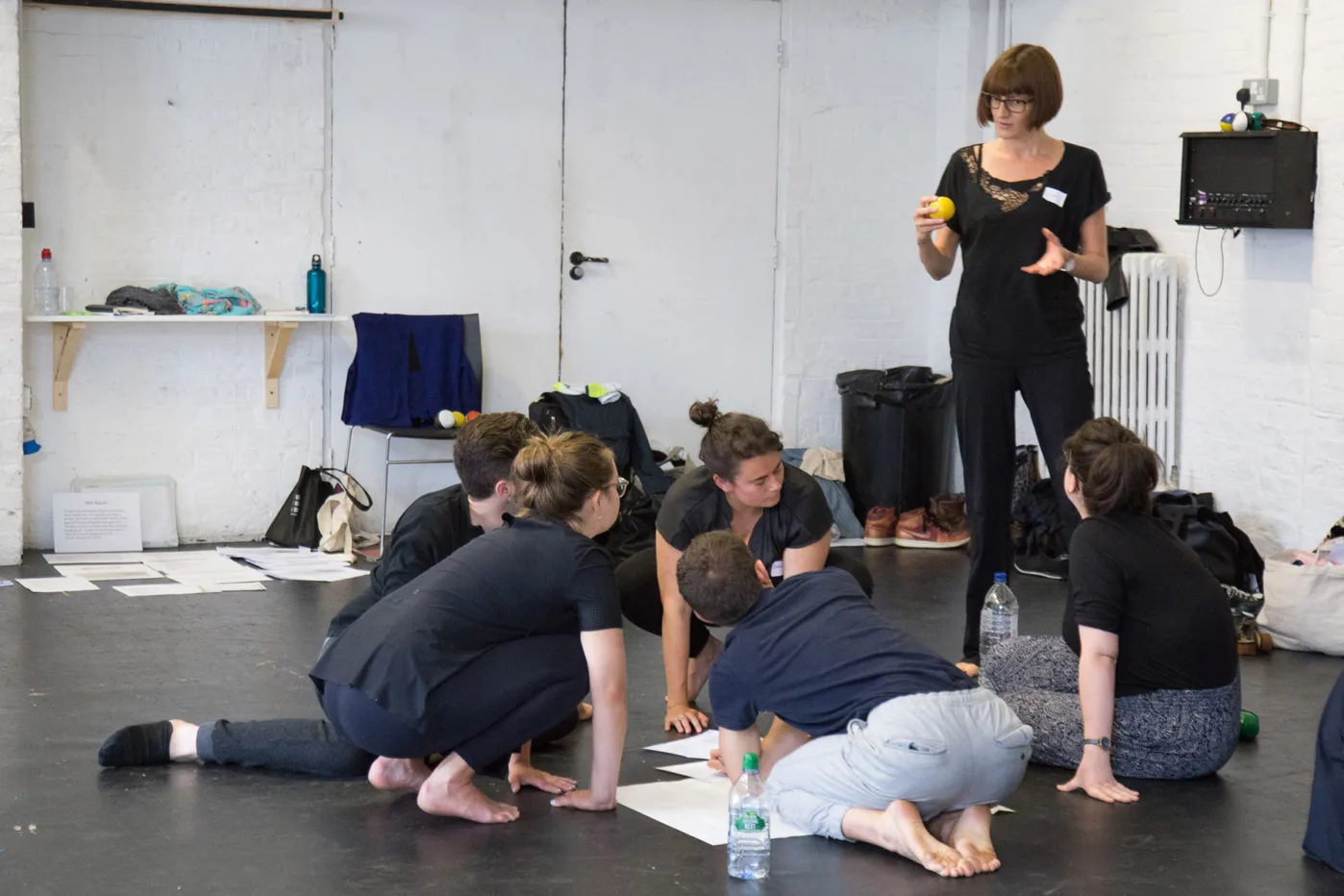
New Pathways was a major multi-institutional research project that involved Goldsmiths, University of London, the Royal Central School of Speech and Drama, Queen Mary University of London, University of Kent, and the professional organisations Michael Chekhov UK (www.michaelchekhov.org.uk) and The Chekhov Collective.
Lead Researchers: Dr Cass Fleming (Goldsmiths, University of London and MCUK) and Dr Tom Cornford (Royal Central School of Speech and Drama and MCUK)
This long-term project was initiated by Dr Cass Fleming, Dr Tom Cornford and MCUK in 2013 and led to a series of Research Events at Goldsmiths, University of London in September 2016.
Research team: Graham Dixon (MCUK), Gretchen Egolf (MCUK) Sarah Kane (MCUK), Julia Krynke (MCUK), Dr Caoimhe McAvinchey (Queen Mary, University of London), Dr Roanna Mitchell (University of Kent), Sinéad Rushe (Royal Central School of Speech and Drama, University of London and MCUK), Martin Sharp (MCUK); Daron Oram (Royal Central School of Speech and Drama) and the practitioners involved in The Chekhov Collective based at Goldsmiths, University of London.
Contributors to the September Events: Marjolein Baars (Holland), Zoe Brooks (Scotland), Professor Franc Chamberlain (UK), Juliet Chambers (UK), Aldonna Cunnigham (UK), Ragnar Friedank (USA), John Gillett (UK), Christina Gutenhunst (UK), Joanna Merlin (USA) and Ulrich Meyer-Horsch (Germany).
Why?
Since the late 1980s interest in Michael Chekhov’s (1891-1955) Technique has grown rapidly in the UK and has been recognized for its innovation and accessibility. Exploration of Chekhov’s imaginative techniques has primarily been limited to acting and actor training practice in the twentieth century. There had been some useful preliminary explorations of other uses of Chekhov Technique but this needed to be taken further. This innovative project brought together professional practitioners and scholars from different disciplines to investigate new uses of Chekhov’s techniques both within and beyond the theatre in the twenty first century.
The genesis of this project was an intergenerational exchange, and subsequent series of edited interviews, within the Michael Chekhov UK about the work in this field and how we could explore new pathways for this practice in the future (Cornford, Fleming and Rushe, 2013). An edited version of this interview published in the Theatre, Dance and Performance Training journal published by Routledge can be access here.
What?
How can Chekhov’s techniques be used in contexts other than actor training designed for the interpretation of existing dramatic literature in a 21st Century context?
Each strand of the project drew on the rich materials held on the work of the Chekhov Theatre Studio at Dartingon Hall in Deidre Hurst du Prey’s Archive and explored how it could be used in new and innovative ways in relation to different practices in the twenty-first century.
To do this we brought together a group of disparate scholars, researchers, therapists, clinicians, social/applied practitioners, theatre practitioners, designers and pedagogues to explore, interrogate and valorize Chekhov’s work in a twenty first century context.
The research question and aims
The central research question we posed in this project was: How can Chekhov’s techniques be used in contexts other than actor training designed for the interpretation of existing dramatic literature in a twenty-first century context?
An additional overarching aim of the project was to extend and diversify the existing Chekhov community both in the UK and internationally. The project was designed to offer completely free and inclusive events to a range of participants who had little, or no, prior experience of Chekhov Technique.
How we explored the new pathways
The research team was comprised of a group of scholars, researchers, therapists, clinicians, social/applied practitioners, theatre practitioners, designers and pedagogues, who explored, interrogated and valorized Chekhov’s work in a twenty-first century context. There were six central strands to the practice research addressing the use of Chekhov’s techniques and principles, led by the following practitioners, which explored the following areas:
- Chekhov Technique for Catalyst Direction and Devised Theatre led by Dr Cass Fleming with Dr Roanna Mitchell and members of The Chekhov Collective UK.
- Chekhov Technique for Collaborative Writing led by Dr Tom Cornford with Dr Hannah Davies, playwright.
- Chekhov Technique for Voice Training and Singing led by Daron Oram, with John Gillett and Christina Gutekunst.
- Chekhov Technique for Movement Training for Actors and Dancers led by Dr Roanna Mitchell with Juliet Chambers.
- Chekhov Technique for Theatre Design led by Sinéad Rushe with Aldona Cunningham.
- Chekhov Technique in Applied, Therapeutic and Community Contexts led by Professor Caoimhe McAvinchey with Zoe Brooks and Martin Sharp.
How?
Cass Fleming explains:
“Each strand of the project drew on the archival materials and explored how they could be used in new and innovative ways in relation to different contemporary practices. The first two strands were longer-term practice research projects, conducted through sustained creative engagement with the approaches and concepts discovered in the archive, whereas the others took a more focused approach to exploring this material in workshops and discussions with practitioners. We explored the rich possibilities the technique offered to the new pathways but also reflected on the problems we faced when we used Chekhov techniques, and the archival materials, in our diverse areas. This involved an open consideration of the shortcomings of specific techniques and the socio-cultural contexts that they were developed within and the challenges of adapting them to our current work. Consequently, we explored how we might we re-consider, interrogate, and develop Chekhov’s metaphors and use of language in a way that stayed true to his principles and methods but engaged with contemporary perspectives and critical frames, and the needs of the different disciplines represented in the project” (Fleming, 2020: 12).
There were two phases of the New Pathways Project. The first involved archival work carried out by Cass Fleming and Tom Cornford to build a shared resource, practice research, and early outreach events for practitioners from various fields. Phase two of the project led to a three-day public research event for 120 participants at Goldsmiths, University of London, in 2016.
Research Events
Dr Cass Fleming launched The Chekhov Collective at Goldsmiths, University of London, to carry out the preliminary experiments related to the directing and devised strand of this. This has led to the development of the practice research work on Antoine de Saint-Exupéry’s The Little Prince and a number of different research events, workshops and practice research performances. You can read more about these various events here. Dr Tom Cornford and Dr Hannah Davies also undertook practice-as-research relating to their strand of the Research Project in 2015, which led to Demons, adapted from Dostoyevsky’s novel and performed at the University of York.
In November 2015 Dr Cass Fleming, Dr Tom Cornford, Dr Roanna Mitchell and five actor-devisers from The Chekhov Collective gave a paper on two strands of the New Pathways Project at Performance Research Forum Dis-Play at Goldsmiths College.
Daron Oram and Sinéad Rushe led a series of workshops exploring the actors’ presence using their blend of Chekhov and Linklater Technique for Voice at the Royal Central School of Speech and Drama and The Actors’ Centre (2015-2016).
National and International Research Events – September 2016
The project culminated with a series of Research Events hosted at Goldsmiths in September 2016 for over 120 participants from the UK and other parts of the world that included:
- A workshop in Chekhov Technique for Non-Actors
- Two Research and Development Performances – one of The Little Prince directed by Cass Fleming and one by Tom Cornford.
- A series of six Praxis-Symposia sessions on the key areas
- Feedback from Academic Auditors
- A series of short papers
- A plenary
- An international Skype exchange with practitioners in other parts of the world


Participants
The various events were designed for practitioners from different fields who were either completely new to Chekhov Technique or have had only a limited opportunity to work with them in the past. These events enabled participants from different fields, for example therapists, theatre designers or teachers of voice, to try a methodology that was new to them and not included in training and provision in their sectors.
The introduction ‘Chekhov Technique: Past, present and future’ of the New Pathways book written by Cass gives more detail on the practice research project, its research questions, methodology and critical context(s).
What Now?
We are delighted to report that the New Pathways project has indeed grown and diversified the Chekhov community, and we are grateful to all the participants for their vibrant and creative contributions to the project.
The research team had hoped that the series of research events and experiments would identify new research questions for future development with our national and international partners and this has been the case for all the authors of the book. Our work has also had impact on other organisations exploring the work of Chekhov Technique in other parts of the world and introduced new and innovative models of practice-research.
The Chekhov Collective has continued to exist as an organisation since 2016 seeking new uses of Chekhov’s techniques in the twenty-first century in many different contexts both within and beyond the theatre. The Collective remains committed to accessible and affordable workshops and research events and continues to bring together participants from a broad range of backgrounds and at different stages in their careers.
The Collective continue to asks new questions, adapt and challenge the techniques for use in a contemporary context, support new experiments and blends with Chekhov Technique, engage in new critical debates and develop new practice and discourse in the UK and around the world.
We hope you might join on us on this journey. Contact us here to join our mailing list.
The institutional affiliations of the six research teams
The institutional affiliation of the six research teams is as follows:
Strand 1. Dr Cass Fleming (Goldsmiths University of London, MCUK, The Chekhov Collective UK), Dr Roanna Mitchell (University of Kent, MCUK, The Chekhov Collective UK) and members of The Chekhov Collective UK.
Strand 2. Dr Tom Cornford (The Royal Central School of Speech and Drama, MCUK) and Dr Hannah Davies, playwright.
Strand 3. Daron Oram (The Royal Central School of Speech and Drama), with Christina Gutenhunst (E15) and John Gillett.
Strand 4. Dr Roanna Mitchell (University of Kent, MCE) and Juliet Chambers (Guildford School of Acting). Strand five. Sinéad Rushe (The Royal Central School of Speech and Drama, MCUK) and Aldonna Cunningham (The Royal Central School of Speech and Drama). Strand 6. Professor Caoimhe McAvinchey (Queen Mary University of London), Zoe Brook (Bazooka Arts) and Martin Sharp (University of Bournemouth, MCUK).