Open House – Chekhov Technique: Dynamic for Scene Work With Cass Fleming & Gretchen Egolf
Time: 2.00-6.00pm | Location: Goldsmiths, Studio 3.
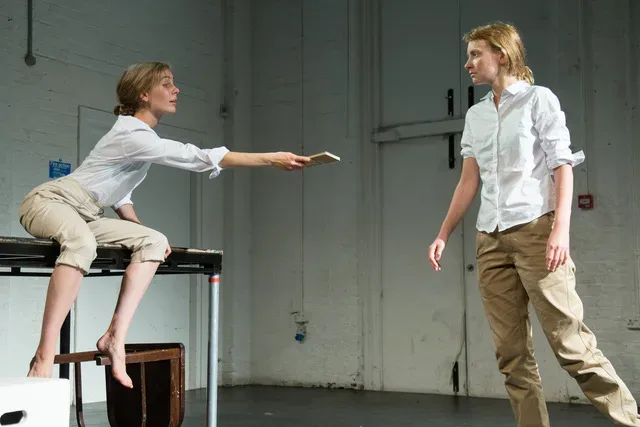
This workshop explores the ways in which Chekhov Technique offers actors and directors effective tools to explore dynamics in the context of scene work and the relationship between characters. This will include the use of gesture, polarity, space and proxemics. We will work with written scenes from a selection of plays in this session. Our Open House workshops are open to complete beginners and those with experience of Chekhov Technique.
This session will be led by Gretchen Egolf and Cass Fleming.
“The practise of exploring text, it would be super helpful for me to develop the text as a director.”
“The freedom, inclusivity and encouragement for everyone to take risks and be bold without fear of judgement.”
Gretchen is an actor, director, and teacher, originally from America, now based in the UK. She was a Co-Director of the Chekhov Collective for a number of years working with Cass Fleming and Roanna Mitchell. She trained at Juilliard and her theatre work includes Broadway (and Off), West End (and Off), and major theatres around the US. She has performed extensively in television and film. As an acting instructor, Gretchen specialises in the Michael Chekhov Technique, having studied with Michael Chekhov Association (USA), Michael Chekhov Studio NY, Praxis Studio (LA), Michael Chekhov Studio London, MC Europe, The Chekhov Collective UK, and other independent teachers and studios. She has taught and/or directed at LAMDA, Royal Central School of Speech and Drama, ALRA, RADA, Brunel, with TCCUK, and in independent practice.
Cass has used Chekhov Technique in her directorial work, and her training of directors, since 1998. She has trained actors, directors, choreographers, devised theatre makers and scenographers in the use of Chekhov Technique at Goldsmiths, University of London, the Royal Central School of Speech and Drama, Rose Bruford Drama School, E15 Acting School and the University of Kent. She has also trained directors in the use of ChekhovTechnique in professional contexts such as the Royal National Theatre Studio, the YoungVic Theatre Directors’ Programme and with the Chekhov Collective. Cass also draws on the techniques developed by Suzanne Bing and her collaborators in France, and number of other directing and making methods. She is a specialist in the use of play in training, making and directing performance. Her PhD explores Chekhov Technique and its use indirecting and she has presented various papers on many aspects of Chekhov’s practice over the past 15 years. Cass was co-lead researcher on the long-term and cross-institutional practice research project that led to the publication of Michael Chekhov in the Twenty First Century: New Pathways, which she co-edited with Tom Cornford(Bloomsbury 2020). She contributed three chapters for this book, including one that addressed the use of the technique for directing and devising theatre.
In addition to her work with Chekhov Technique Cass has also been exploring and researching the work of the French actor, director and actor-trainer Suzanne Bing since1998 and has shared her research widely since that time (2008, 2013, 2014, 2020). She has also collaborated with Mark Evans on the work of Jacques Copeau and Bing’s contribution to his practice (2018). Cass also has a long-standing interest in developing non-canonical approaches to, and histories of, actor training and she conceived a special edition of the Theatre, Dance and Performance Training journal entitled ‘Against the Canon’ (11:3) which she co-edited with Mark Evans and Sara Reed (Routledge, 2020)
Accessibility: The studio at Goldsmiths is wheelchair accessible. Please email us with any access requirements at thechekhovcollectiveuk@gmail.com.
Cost: We are keen to make our workshops as accessible as possible, and there are concessions available. If you would like to make a special application for a free ticket, please contact us via email at thechekhovcollectiveuk@gmail.com.