Chekhov Technique: In Applied Theatre, Therapeutic and Community Contexts
This page gathers together various aspects of The Chekhov Collective’s research exploring Michael Chekhov’s technique in the context of applied theatre, therapeutic and community contexts. This work has developed out of partnerships and exchanges among a number of artists and scholars in the field, who are referred to below and/or in associated publications.
Whether you come here as a scholar, artist, teacher, or all of those, we hope the information collated here is useful to you.
Michael Chekhov on the socio-political role and wellbeing potential of theatre and his techniques
Chekhov believed that theatre had a social and political responsibility and spent much of his life developing not only methods used for acting, but also specific techniques and approaches that can be used by directors, teachers and facilitators working with groups. Moreover, Chekhov’s approach was fundamentally participant centred, attended to the holistic needs of all those involved and rooted in ensemble practice.
The Chekhov Collective has pioneered an exploration of the use of aspects of Chekhov Technique, in combination with other methods and approaches, in relation to politically aware theatre practice, participant empowerment and wellbeing, community engagement, and therapeutic practices in the UK.
Beginnings: The New Pathways Practice Research Project
Zoe Brook a Drama Therapist and Co-Director of Bazooka Arts based in Glasgow had been using the technique in her work, and Cass Fleming had been introducing selected methods to undergraduate and postgraduate applied theatre makers, in addition to student actors, directors, choreographers and devised theatre makers at Goldsmiths, since 2005 when they trained together with Graham Dixon. Martin Sharp, a founder member of Michael Chekhov UK, had also been drawing on the technique in his work as a therapist for a number of years and as a teacher at Bournemouth University.
The New Pathways Research Project (2013-2016) included a strand of research which specifically focused on the uses of Chekhov Technique in these contexts which was led by Professor Caoimhe McAvinchey (Queen Mary, University of London) in partnership with Zoe Brook and Martin Sharp. Together they developed a dynamic praxis-symposium workshop as a form of knowledge exchange with other practitioners working in drama and movement therapy, psychotherapy and community practice at Goldsmiths in 2016. Graham Dixon also led a Chekhov Technique workshop specifically for non-Actors to welcome a number of therapists and practitioners from other fields.
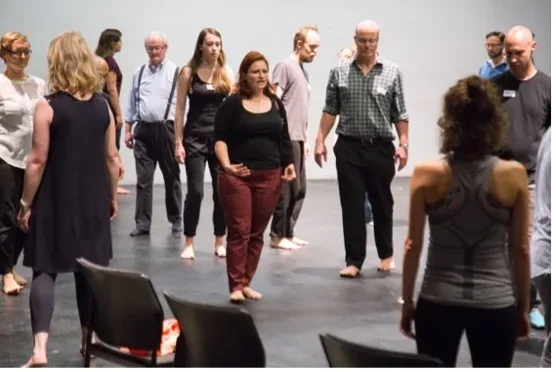
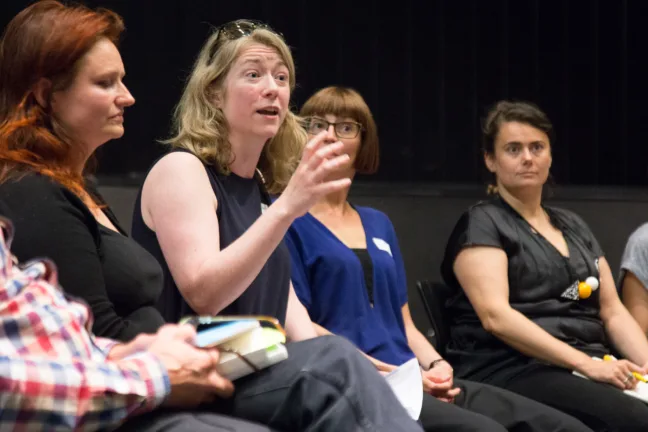
New Pathways Praxis-Symposia, photo: Katerina Kotti
Caoimhe subsequently wrote a chapter about the work of Zoe and Martin, along with Effie Makepeace based in the UK and internationally, and Hartley Jafine’s work in the health care context in Canada, in the New Pathways Publication (Fleming and Cornford 2020).
Cass Fleming and Tom Cornford wrote about the work of Marjolein Baars in Holland in relation to her use of Chekhov Technique as clown doctor and with elders with Dementia and their families. Cass and Tom also discussed the underlying principle of Ensemble in Chekhov’s approach, in contradistinction to notions of individualism, his belief that theatre practice must fundamentally work for humanity and society and an understanding that the ‘how’ of directing, teaching or facilitation, is deeply political and requires the development of specific skills, political awareness and abilities (Fleming and Cornford, 2020:179-182).
Developments: Chekhov Collective Events and Collaborations
International partnerships and knowledge exchange
The New Pathways book discussed the significance of the early work of European Chekhov practitioners in this area, in particular Marjolein Baars in Holland and Joerg Andress in Germany, and noted the growth in practitioners using Chekhov Technique in these other contexts around the world.
The University of Kent subsequently funded a networking and knowledge exchange event run by The Chekhov Collective called ‘Open Doors: Social and Applied Contexts’ which was held Friday 29 November – Sunday 1 December 2019 at the University of Kent. At this event Roanna and Cass were joined by Zoe Brook (Scotland), Professor Luciana Barone (Brazil), Jessica Cerullo (USA), Marjolein Baars (Holland), Joerg Andrees and Anna Katharina Andrees (Germany) and Martin Sharp (UK). Click on our colleagues’ names to find out more about their inspiring practice.
Workshops, Symposium, Presentations and Knowledge Exchange Events and Resources
1. Chekhov Technique in Dramatherapy — Workshop
Since 2016, Zoe Brook has offered training in Chekhov Technique specifically for drama therapists both with The Chekhov Collective, of which she is a key member, and other organisations. Click here to read about Zoe’s workshop ‘Chekhov Technique in Dramatherapy’ which was delivered on Saturday 19 October 2019 at Goldsmiths.
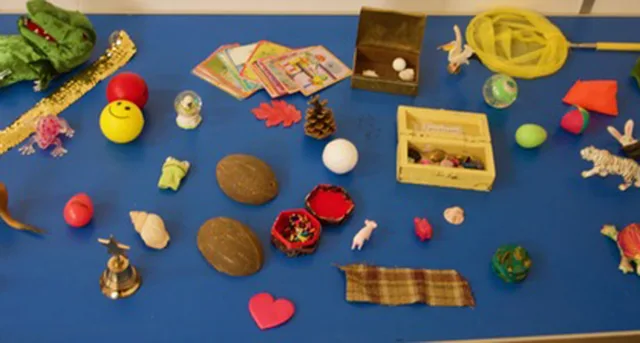
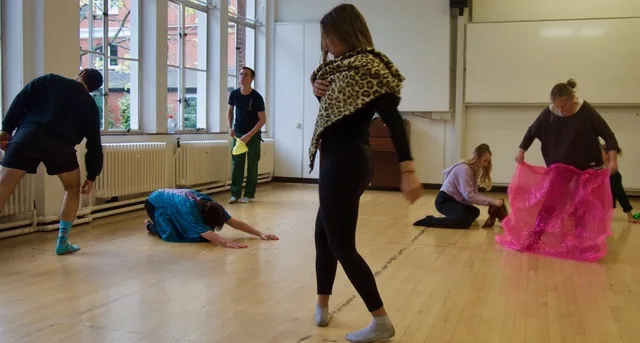
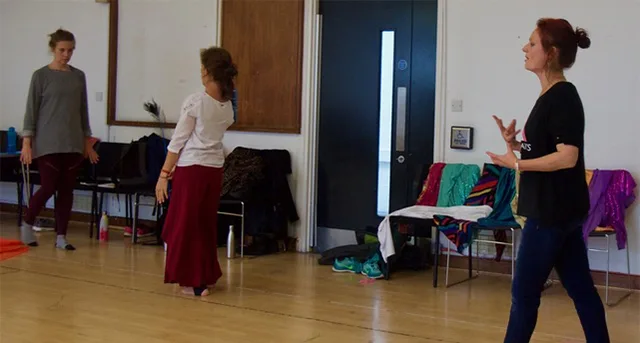
‘Chekhov Technique in Dramatherapy’ 2019.
2. The Third Space — Scholars’ Lab
In 2019-2020 Cass and Roanna were awarded the role of Joint Scholars in Residence for MICHA for their research project titled ‘The Third Space’. This explored the potential functions of Chekhov’s techniques as transformative catalysts in relation to self, identity and others, within pedagogic, applied, therapeutic, community and political contexts. This work considered the potentiality of the creative and inter-personal space/s created between the facilitator/teacher, the participant/student and the group as ensemble as a powerful, but indirect, therapeutic and inter-personal dimension of Chekhov’s practice. Roanna and Cass designed a two-day workshop that explored their practice research in this area, and Roanna delivered these workshops for a group of international practitioners over Zoom on the 18 and 19 June 2020 at the MICHA annual workshop.
3. Michael Chekhov: Imagination and Community — paper and publication
In February 2021, Cass delivered a paper at the Performing Arts in Times of Crisis (II) Conference at Brazil Universidade Estadual do Paraná. The paper, ‘Michael Chekhov: Imagination and Community’ explored the use of Chekhov Technique in the context of the Covid-19 pandemic. This later became a journal article in Revista Científica de Artes which is available here.
4. Chekhov in Challenging Times — Workshops and social arts projects
Jessica Cerullo, Artist Director of the Michael Chekhov Association based in the USA (MICHA) and socially engaged artist, designed and delivered a session exploring ‘Chekhov in Challenging Times’ on Saturday 20 March 2021. The session was a tonic for creativity and self-care in the midst of a dark lockdown spring of the Covid 19 Pandemic. Jessica then returned to the Collective to share a session based on her social practice art projects ‘Ships in the Night’ on Saturday 2 April 2022 which she developed with 50 participants living through the Covid pandemic. You can learn about Jessica’s socially engaged practice on her website here. She is also a board member of The Chekhov Collective.
You can watch the full recording of ‘Chekhov in Challenging times’ below:
VIDEO
5. ‘Chekhov and Community’ — Presentation
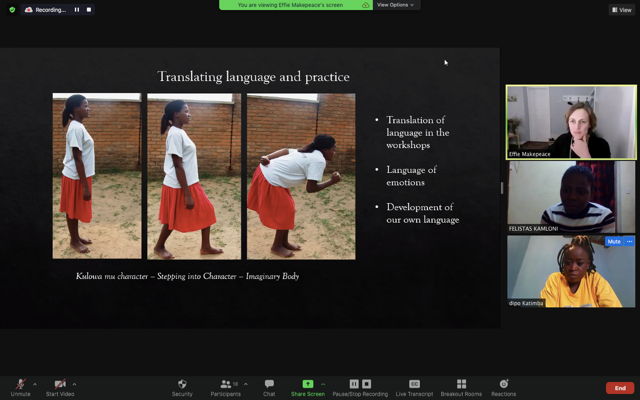
Effie Makepeace, a community theatre practitioner who works in the UK, Malawi and India, together with Dipo Katimba and Felistas Kamlonie who are based in Malawi, led a session ‘Chekhov and Community’ on Saturday 8 May 2021. The session addressed the work they have undertaken together on a long-term project in Malawi that led to the creation of Khamalathu Arts women’s theatre group
Effie Makepeace has been using theatre with communities since 2008 – running workshops, conducting research, devising and touring performances. She works with groups in UK, Malawi and India on projects which range from a few days to sustained engagement over several years. Her practice is a patchwork of different influences and ideas, one of whom is Chekhov whose work she has referenced, played with and adapted in different ways. She is currently writing her PhD at the University of Sussex along with co-researchers Khamalathu Arts, looking at theatre workshops as spaces to investigate and understand power with groups of women. Her research and practice interests are theatre for research, theatre for reflective practice, and collaborative and decolonial methods.
Khamalathu Arts are a collective of ten women from Blantyre, Malawi. They started meeting through a local NGO, Girls Empowerment Network in 2007. Then the group was contacted by Nanzikambe Arts in 2008 and through them started doing weekly drama workshops with Effie Makepeace and Dipo Katimba. This involved training in theatre skills influenced by practitioners sure as Augusto Boal and Michael Chekhov. That work lasted for four years. After that ended some of the group went on to work as performers in different organisations and theatre groups. In 2017 they decided to start their own new group ‘Khamalathu Women’s Group’ to be independent, to continue the work they have started and to use their skills to help others. The group makes theatre together but also conducts research projects, after receiving training and acting as co-researchers on Effie’s PhD.
Felistas Kamlonie is an actor and facilitator from Malawi. She is a member of the Khamalathu Arts and also works with Nkhokwe Arts, a theatre group of ex-prisoners as well as facilitating workshops with sex workers, young women and women in prison. She has also worked in Germany where she was due to act in King Ubu at Theater Konstanz (adapted to a radio play after the Covid-19 pandemic) and online with Cardboard Citizens, co-facilitating women’s workshops.
Dipolathu Katimba is an actress, artistic director, writer and director from Malawi. She has been working as an actress since 2004 and has played in numerous plays that were shown in Malawi, South Africa, Botswana, Zimbabwe, the UK, Germany and Norway. She is the artistic director of theatre company Pamthunzi Arts which works in local communities and supports the participants in developing various skills. Amongst other things she has co-written the script ‘The Secret Life of Us’, based on research into the lives of sex workers in Malawi. The play was chosen to be presented at the Women’s Playwrights International Conference in Sweden. She has worked several times with Theater Konstanz in Germany, most recently in 2020 in their production of King.
To watch this session, please email us the contact form to request access.
6. Wellbeing in the theatre profession through Chekhov’s principles — Workshops
Gretchen Egolf, a key member of the Collective, has run many workshops over the years, two of which focussed on issues of social engagement and wellbeing in the theatre profession ‘Illuminating the Shadow: Finding Love in Our Profession’ on Saturday 9 March 2019 and her Open House workshop delivered during the lockdown ‘Creating Character’ on Saturday 1 May 2021. The first session sought to share tools to enable artists to fight the overwhelm of occasional darkness in material or in our lives which sometimes negatively affects our creativity, and the second integrated meditative practices.
7. Chekhov technique in Inclusive Dance Practice — Workshop presentation
Grace Wranosky delivered a presentation on ‘Chekhov Technique in Inclusive Dance Practice’ about her work with Confidance, an inclusive dance company working with dancers with learning disabilities in Kent, on Saturday 27 November 2021.
Grace’s session is available to watch here.
8. Chekhov in relation to Dance, Circus and Inclusive practice — In Conversation
This interview with Anna Katharina Andrees about her practice in movement and inclusive circus arts was hosted by Roanna on 21 July 2021 as part of her research exploring uses of Chekhov technique in movement practice. Anna Katharina is the founder of the Zentrum fuer Bewegte Kunst e.V. in Berlin, ran the inclusive circus company Sonnenstich, and is now the lead of 7Women company.
You can access the full interview here.
9. Chekhov and the potential for feminist and political practice — research seminars and publications
Cass Fleming has also explored the issue of Chekhov’s own identity and personal history in relation to his empowering techniques – and why these methods hold potential for feminist and political practice – in her research (2013) which you can access here. She also shared some of this work as part of a seminar dialogue with Margaret Kemp, Gretchen Egolf and Jessica Cerullo: ‘Michael Chekhov and Identity’. This seminar was co-produced by The Chekhov Collective and MICHA and held on Friday 14 May 2021. Cass, Gretchen and Jessica Cerullo also established a second seminar, ‘Michael Chekhov and Eastern Spirituality’ co-hosted by The Chekhov Collective and MICHA, with Professor Jerri Daboo and Anjalee Deshpande Hutchinson as speakers, chaired by Jessica Cerullo. You can access the full recording here.
10. Gestures of Repair Practice Research Workshop
Roanna delivered a workshop on ‘Gestures of Repair’ on Saturday 29 May 2021 that shared aspects of her practice research and methodologies around performance training and mental health, developed through her long-term research.
The projects Roanna built on in this workshop include
- MacroMap, a tool for holistic reflection that she developed for students and as a way to evaluate the impact of creative practice research,
- Creative approaches to mental and social health developed through the ongoing Inappropriate Anger project with survivors of Borderline Personality Disorder Diagnosis, initiated with Louisa Harvey
- Poetry and Performance workshops delivered for Margate Recovery College students at the Turner Contemporary in Margate
- Performance/arts project The Escapologist
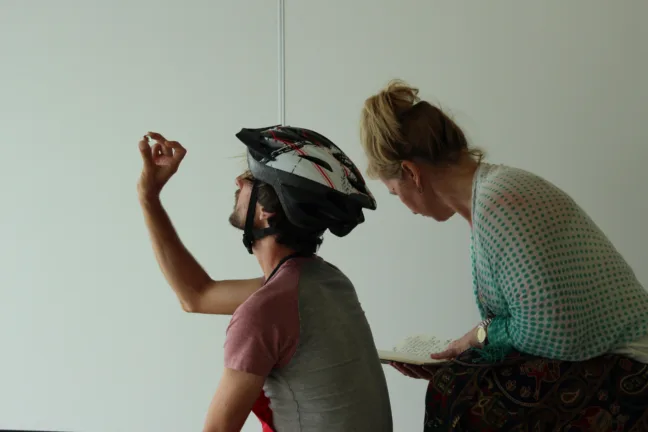
11. Article – the therapeutic potential of pyscho-physical performer training
In 2022 Roanna also published an article ‘Not not doing therapy: Performer training and the ‘third’ space’ in Theatre, Dance and Performance Training that built on her earlier work related to body politics and wellbeing in actor training.
The 2022 article explores, amongst other things, the therapeutic potential of using psycho-physical performer training techniques, including Chekhov Technique, with participants and students.
12. Theatre, Performance and Relational Repair Symposium
Roanna and the Chekhov Collective, in partnership with Dr Jayne Thompson (Moving Memory Dance Theatre) and the Theatre and Performance Research Group at the University of Kent, curated and led a one-day symposium which explored how we might navigate trauma, relational repair and being-with each other in and through performance, research and teaching. The sessions approached the topic from various intersecting points of view, and the day aimed to facilitate the exchange of ideas, questions and practice between all participants.
Polly Teale ran a workshop and Q&A session titled ‘Brave Space: Supporting Creative Courage’, papers were presented by Dr Sophie Quirk and Jessica Cerullo and Dr Max Pickard (psychiatrist) who presented on ‘Understanding Trauma: Teaching Psychodynamic Principles’. See the full programme here.
13. Book Chapter: Gesture in Actor Training and with Survivors of BPD Diagnosis
Roanna discusses her work using Chekhov technique in mental health contexts in her chapter ‘Gesture in Actor Training and with Survivors of BPD Diagnosis: Finding communication towards relational thirdness’ in the book Trauma and Embodied Healing in Dramatherapy, Theatre and Performance, ed. J.F. Jacques (Routledge, 2024).
14. Relational Arts Workshops (RAW): AHRC-funded impact project
In 2023 Roanna received AHRC Impact Accelerator funding to deliver a programme of impact events for Trainee Psychiatrists, in partnership with KMPT. This work, taking place in 2024, is a development of the Inappropriate Anger project. Roanna presented on this project at the Kent Medical Humanities Conference in October 2023.
An empowering and therapeutic technique
A key finding of our research and various knowledge exchange projects is that the majority of practitioners we have worked with at the Collective find a use of Chekhov Technique to have wellbeing and potentially therapeutic outcomes when carefully used in any context. In part this is perhaps because the technique is so profoundly participant-centred and because while it is psychophysical and expressive of participant’s creative individuality it does not draw directly on their personal emotional memories and potentially re-connect directly to trauma. The techniques are relational, they connect people to their imaginations, the world and each other. Moreover, the use of the participant’s energy and imaginative capacity can offer new experiences and different ways of understanding themselves. For many practitioners, this also introduces a political dimension in relation to what the technique can offer and the social and political questions it raises not only about the world but the ways in which we work with our collaborators and participants.
Consequently, many of the projects you will find in different areas on our website, for example, ‘Chekhov and Body Mind Centring’ developed by Professor Luciana Barone, or ‘Exploring Chekhov through Play’ developed by Cass, also indirectly explore this important intersection.
The Collective continues to explore this area of work and welcomes any practitioner currently using or experimenting with Chekhov Technique and other practices to contact us to discuss a potential research event about their work, or a knowledge exchange session.